The Importance of Staying in the Present
Most people spend surprisingly little time actually paying attention to the moment they are in. The mind drifts toward what already happened, toward what might happen next, or toward some future version of life that has not arrived yet, while the present moment quietly passes by, mostly unnoticed.
This piece looks at why this pattern is so common, what research says about its effect on well-being, and why the present moment might be the only place where life actually happens.
The Wandering Mind
In 2010, two Harvard psychologists, Matthew Killingsworth and Daniel Gilbert, ran a study that measured this directly. Using a phone app that pinged thousands of people at random points during their day, they asked two simple questions:
- What are you doing right now?
- Are you thinking about something else?
The results showed that people’s minds wandered away from what they were doing almost half of the time, 46.9 percent, no matter how enjoyable the activity was.
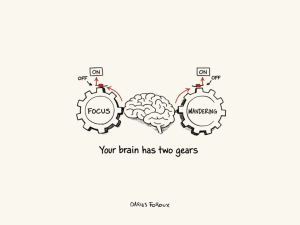
The more interesting part was about happiness. Mind-wandering was more closely linked to lower happiness than the activity itself was. In other words, what people were thinking about mattered more for their mood than what they were actually doing.
As the researchers put it, being able to think about things other than the present is a real mental ability, but it comes at a cost. This goes against the common idea that happiness depends mostly on outside circumstances. It suggests that where a person’s attention is placed matters just as much.
An Old Warning About Delayed Living
Long before this could be measured, philosophers had already noticed the same thing. The Roman Stoic philosopher Seneca wrote about it directly in his essay On the Shortness of Life, almost two thousand years ago. He observed that people often put off the things that matter most: meaningful work, relationships, and reflection, because they assume there will be more time for those things later, “at fifty” or “at sixty”. His argument was that this habit of postponing, more than any real shortage of time, is what makes life feel short. In his words, life is not short; people just waste a lot of it.
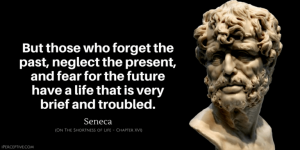
Seneca’s main point was that living for the future quietly uses up the very time it claims to be protecting. Every day spent preparing for a better future is a day that was not actually lived. This idea was written for people in ancient Rome, but it fits a very familiar modern habit: treating the present as just a step toward some later, “real” version of life.
Ambition and the Arrival Fallacy
This shows up clearly around ambition and achievement. Positive psychologist Tal Ben-Shahar, who used to teach at Harvard, coined the term “arrival fallacy” for a common experience: believing that reaching a goal, such as a promotion, a degree, or a relationship, will bring lasting happiness, and then finding out it does not. He came up with the idea partly from his own experience as a competitive squash player, after winning a national title and feeling much less satisfied than he expected to.

The arrival fallacy shows something important about how ambition affects the present. Working toward a goal often pushes a person’s sense of “real life” into the future, based on the assumption that satisfaction is waiting at the finish line rather than available along the way.
But people adapt quickly to new circumstances, something researchers call hedonic adaptation, so the satisfaction of reaching a goal fades fast, and attention moves to the next target almost right away. The result is a cycle where fulfillment always seems to be just ahead, never quite in the present.
What Attention Actually Means
If both ancient philosophy and modern psychology point to the same problem, they also point to a similar solution: Attention. Jon Kabat-Zinn, the scientist who brought mindfulness into mainstream medicine, defines it as awareness that comes from paying attention, on purpose, to the present moment, without judgment.

The phrase “on purpose” matters here – it separates mindfulness from just happening to be present, which, based on the Killingsworth and Gilbert data, is not how most people’s minds naturally work. Staying present, by this definition, is something people have to practice on purpose, because the mind’s default setting pulls in the opposite direction.
Here are a few concrete ways to practice it:
- Walking: Feel your feet hitting the ground, your breath, the air on your skin instead of thinking about what’s next; even 2-3 minutes counts.
- Routine tasks: Pick something repetitive (washing dishes, brushing teeth) and actually notice the sensations instead of letting your mind drift.
- Naming emotions: When something stirs you up, silently name it (“this is anxiety,” “this is frustration”) instead of reacting or judging it. That is the “without judgment” part of Kabat-Zinn’s definition.
- Body scan: Before getting in bed, spend 5 minutes noticing each part of your body head to toe; no need to change anything, just notice.
The common thread: Mindfulness is not about having an empty mind. It is about deliberately pulling attention back to the present, since research shows the mind wanders almost half the time by default.
Conclusion
In summary, these findings point in the same direction. Research shows that a wandering mind, one caught up in the past or the future, is measurably less happy than a mind focused on the present. Philosophy noticed the same pattern long before it could be studied, warning that putting off life for some future version of it is what makes life feel short. Research on ambition adds another layer: even reaching the goals people delay the present for rarely brings the lasting satisfaction they expect.
We can only remember the past, and we can only imagine the future. Neither one can actually be lived. The present, however ordinary it might feel, is the only point where life actually happens.
Sources
- Killingsworth, M. A., & Gilbert, D. T. (2010). “A Wandering Mind Is an Unhappy Mind.“
- Science, 330(6006), 932, Harvard Gazette summary; original paper (PDF)
- Seneca, On the Shortness of Life, summary and quotes, James Clear, Sloww deep summary
- Tal Ben-Shahar and the “arrival fallacy“, Psychology Today, Stylist.
- Jon Kabat-Zinn’s definition of mindfulness, Mindful.org.