The Difference Between Knowing and Understanding
Most people can repeat something back and feel, right in that moment, like they know it. Far fewer people can actually use that same thing once the situation changes even a little. That gap between knowing and understanding is easy to miss, because both feel almost the same from the inside… until something forces you to notice the difference. Psychology has actually studied this gap directly, and the findings are pretty eye-opening. Here are the things:
You Know Less Than You Think You Do
Try this for a second: pick something ordinary you would say you understand pretty well. How a zipper locks together. How a toilet actually flushes. How a bike stays upright without falling over. Most people would rate their understanding of these things fairly high without a second thought.
Back in 2002, two psychologists, Leonid Rozenblit and Frank Keil, tested exactly this. They asked people to rate how well they understood everyday objects like these. Confidence was high, just like you would expect. Then they asked people to actually explain the mechanism, step by step, in real detail – not just “it locks the teeth together”, but how, mechanically, that actually happens.
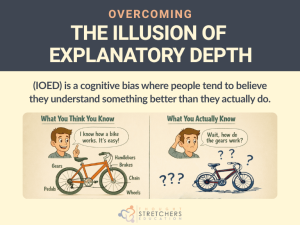
Confidence basically fell apart. People’s own ratings of how well they understood the thing dropped sharply, once they had to produce a real explanation instead of just a vague gesture at one. This became known as the “illusion of explanatory depth” – and it is not something that only happens with gadgets.
The same pattern shows up with scientific ideas, political opinions, even policies people feel strongly about. People genuinely believe they understand something clearly, right up until they are asked to explain it out loud, slowly, without skipping steps.
Feeling Like You Learned Something Does Not Mean You Did
This same gap shows up in how people study, and there is some pretty solid data on it. In 2011, researchers Jeffrey Karpicke and Janell Blunt ran a study comparing two ways of studying a science text.
- One group used concept mapping – drawing out diagrams connecting ideas, a method that is often taught as a “deep” way to learn.
- The other group did something much simpler: they just tried to recall and write down what they remembered, without looking at the text.
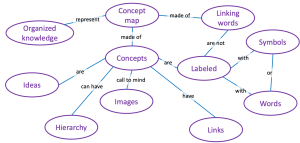
A week later, the group that just tried to recall things from memory did better on a test than the concept-mapping group, and this held even when the test itself was to draw a concept map, the exact task the other group had spent all their time practicing. What is even more interesting is that students did not see this coming at all.
Before the test, most of them guessed concept mapping would win. It did not. Actually trying to pull information out of your own head, with nothing in front of you to lean on, built a stronger kind of understanding than carefully organizing the material ever did, even though organizing it felt like the “smarter”, more thoughtful thing to do at the time.
So What Actually Counts as Understanding?
Put these two studies together, and a pretty clear picture shows up. Knowing something, in the shallow sense, just means you can recognize it, recall the shape of it, or talk around it smoothly. Understanding something means you could rebuild it from scratch, explain why it works and not just what it is, and actually use it in a situation that looks nothing like the one you first learned it in.
This is not just some obscure academic idea either – it lines up with something most people have noticed in real life. You can define a word perfectly on a test and still not really know how to use it in a sentence. You can watch someone solve a math problem and nod along, totally convinced you get it, and then freeze the second you’re handed a slightly different version of the same problem.
What both of these studies add is an explanation for why this keeps happening. It is not that people are lazy or not paying attention. It is that feeling fluent and actually having already seen it feels like learning, because the words get easier to read each time, not because your actual grasp of the idea has gotten any deeper. Recognizing a concept in a textbook feels like knowing it, right up until someone closes the book and asks you to explain it on your own.
The Honest Way to Tell the Difference
So if knowing and understanding feel the same while they’re happening, how do you actually tell them apart?
Based on this research, there is really only one honest test:
- Try to use what you learned somewhere it has not been used before.
- Explain it out loud without notes.
- Apply it to a slightly different problem.
- Teach it to someone else without peeking back at the source.
None of those things feel as comfortable as rereading your notes one more time or nodding along with something that sounds familiar. But that discomfort is actually the point – it is the moment where the gap between “I recognize this” and “I could rebuild this from nothing” finally shows itself. The uncomfortable version is usually the one that’s actually teaching you something. The comfortable version just feels like it is.
Sources
- Rozenblit, L., & Keil, F. (2002). “The Misunderstood Limits of Folk Science: An Illusion of Explanatory Depth.” Cognitive Science, 26(5), 521–562.
Original study; summary - Karpicke, J. D., & Blunt, J. R. (2011). “Retrieval Practice Produces More Learning than Elaborative Studying with Concept Mapping.” Science, 331(6018), 772–775.
PubMed; results summary