The Map Is Not the Territory
Every tool people use to understand the world: language, scientific theories, statistics, even memory itself, is a simplified stand-in for something far more complicated than the tool can fully capture. That simplified version is useful precisely because it is simpler than reality. The problem starts when the simplified version gets mistaken for reality itself.
This piece explains where that idea comes from, why it shows up across very different fields, and what happens when people forget the difference between a model and the thing it represents.
Where the Idea Comes From
The phrase “the map is not the territory” comes from Alfred Korzybski, a Polish-American scholar who first used it in a 1931 lecture and later built it into his 1933 book Science and Sanity. He used it to start a field called general semantics, which studies how language and abstraction shape the way people understand things. His main claim was that people never get direct, unfiltered access to reality. What they get instead is a “map” – a mix of perceptions, beliefs, and words, shaped by their senses and experience – which stands in for the real “territory” of the world.
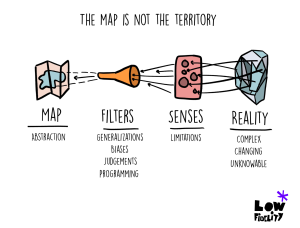
Korzybski applied this to language too, arguing that a word is not the thing it names, in the same way a map is not the actual place it shows.
- A map can be extremely useful: Korzybski pointed out that a good map works well precisely because its structure matches the structure of the territory, but it is still a simplified version.
It leaves things out, simplifies boundaries, and reflects the choices of whoever made it. The real mistake is not using a map. It is treating the map as if it were the territory itself.
The Same Idea Shows Up in Science
Decades later, a similar warning showed up independently in statistics. British statistician George Box wrote in a 1976 paper that since every model is wrong in some way, a scientist can not make one “correct” just by adding more complexity to it – the real goal should be a simple, useful approximation, not a perfect copy.
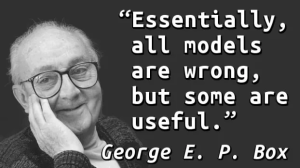
His most famous line “all models are wrong, but some are useful” makes the same point as Korzybski’s map: a model is never an exact copy of reality, but a good one can still be extremely valuable if it captures what matters most about the thing it is describing.
This way of thinking avoids two opposite mistakes. One is throwing out models altogether just because they are imperfect, which would make science, engineering, or any kind of planning impossible, since people can never work directly with raw, unfiltered reality. The other mistake, and the more dangerous one, is forgetting that a model is a simplification at all, and treating its output as if it were reality itself.
When the Map Gets Mistaken for the Territory
This second mistake has had real, expensive consequences.
- One of the clearest examples is the 2008 global financial crisis. In the years before the crash, banks and credit rating agencies widely used a mathematical tool called the Gaussian copula, created by analyst David X. Li, to estimate how likely it was that many mortgages bundled together in one investment would all default at the same time.
The model was built on a fairly short stretch of market data, and it assumed that different mortgages defaulting were mostly unrelated, which based on the fact that, in that data, defaults had rarely happened all at once.
- When the U.S. housing market crashed in 2007, that assumption fell apart. Mortgage defaults, which the model treated as mostly independent events, suddenly started happening together on a massive scale, because they shared one cause: home prices dropping nationwide.
The model simply was not built to handle that kind of shared, extreme event, and its risk estimates turned out to be badly wrong exactly when accuracy mattered most. Institutions that had trusted the model’s numbers as if they reflected actual risk, instead of a rough approximation built on a narrow slice of past data, ended up holding massive losses the model had said were almost impossible. In other words, the Gaussian copula was a map. It worked fine under the conditions it was built for, but the people relying on it mistook it for the territory itself.
Why Does This Matters Beyond Finance?
This same pattern shows up far beyond financial models.
- A scientific theory is a map of physical reality: useful for making predictions, but always open to revision as new evidence comes in.
- A person’s mental image of someone else, built from a handful of past interactions, is a map of that person, not the actual person, and it can be wrong in ways that are easy to miss.
- Even everyday language works as a map: the word “tree” stands in for an enormous range of actual trees, none of which is fully captured by that one word.
In every case, the model is not useless, often it is the only practical way to deal with something too complex to grasp all at once, but it is still a simplified version, built for a purpose, shaped by the limits of whoever made it.
Conclusion
The map-territory idea, first put into words by Korzybski and echoed independently in science, statistics, and everyday thinking, points to one consistent lesson: representations of reality like language, mental models, scientific theories, mathematical formulas are essential tools, but they are not reality itself.
The 2008 financial crisis shows what happens when that distinction gets forgotten under real pressure: a model built on limited assumptions was treated as an accurate picture of risk, and the gap between the map and the territory ended up being extremely costly.
The lesson is not to stop trusting models altogether, since almost all understanding relies on some kind of simplification. It is to stay aware that the simplification is never the real thing, and to keep checking the map against the territory it is supposed to represent.
Sources
- Alfred Korzybski and the origin of “the map is not the territory”.
Reality-Based Living, Map–territory relation, Wikipedia - George Box and “All models are wrong, but some are useful”.
Wikipedia, “All models are wrong”, Statistical Modeling blog - The Gaussian copula and the 2008 financial crisis – Felix Salmon, “Recipe for Disaster: The Formula That Killed Wall Street”, Wired (2009)
Samuel Watts summary and analysis, MacKenzie & Spears academic study