The Art of Losing
Nobody really teaches this skill, but almost everyone needs it at some point: how to lose at something and still walk away okay. Most advice on this stays pretty vague – “learn from it”, “do not give up” – without actually explaining what happens psychologically when people fail, why it hurts as much as it does, or what makes one loss turn into a lesson while another just leaves a scar. It turns out there’s real research behind all three of those questions.
Why Losing Feels Like It’s About You
The sting of losing rarely stays where it started. A missed shot, a rejected pitch, a bad grade… These are supposed to be about one specific attempt, but they often quietly turn into something about the person who made it.
Psychologist Carol Dweck, who spent decades studying how people react to failure, described this shift directly: for a lot of people, failure stops being something that happened and becomes something they are. “I failed” turns into “I am a failure” – a small change in wording that reflects a much bigger shift in how someone processes a setback.
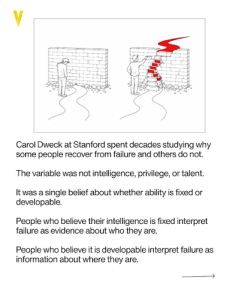
- Dweck connected this to what she called a fixed mindset: the belief that ability is something fixed rather than something you can grow, which makes any failure feel like proof of a permanent limit instead of just information about one attempt.
The clearest evidence for this comes from an experiment Dweck ran with psychologist Claudia Mueller in 1998. Fifth graders solved some problems and were then praised either for being smart (“you must be smart at this”) or for working hard (“you must have worked hard”). Afterward, when given a choice between an easier task or a harder one, about 92 percent of the kids praised for effort picked the harder problems, compared to only 33 percent of the kids praised for intelligence. When both groups were then given a genuinely tough set and allowed to fail, the “smart” group’s scores dropped by almost a full point compared to before, while the “hardworking” group’s scores actually went up by more than a point. And 38 percent of the kids praised for intelligence, about three times the rate of the other group, lied about their scores to other kids afterward, as if the failure had become something to hide instead of something to work through.
It is worth mentioning that later research has complicated parts of Dweck’s broader theory. Some large classroom studies found that changing what students believed about intelligence did not reliably change how they actually performed after failing, even when it changed what they said about it. Still, the original praise experiment holds up well, and it points to the same basic idea: one sentence of praise was enough to change whether a setback later felt like a data point or a verdict, and that changed both how hard the kids tried and how honestly they talked about what happened.
The Trick People Play to Protect Themselves
If failure can feel like a judgment on someone’s worth, it makes sense that people would look for ways to avoid really trying in the first place, because an attempt that never happens can not really be judged.
- This is the main idea behind psychologist Martin Covington’s self-worth theory: people are strongly motivated to protect how competent they feel, sometimes even at the cost of their actual performance.
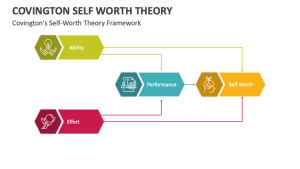
Covington found that people feel far more shame failing after putting in real effort than failing after barely trying, because a serious effort that fails looks like proof of low ability, while a half-hearted one leaves that question conveniently unanswered.
This creates a pattern researchers call self-handicapping: procrastinating, under-preparing, or making excuses in advance, all of which give someone a built-in explanation for failure that has nothing to do with actual ability. Covington and his co-researcher Carol Omelich showed this directly in a 1979 experiment. College students rated how much shame they expected to feel after failing a test, either after studying a lot or barely studying at all. As the theory predicted, students expected to feel a lot less shame if they would barely study. Low effort gave them a convenient excuse that had nothing to do with how capable they actually were.
The same study then had participants switch roles and act as teachers, handing out punishment to hypothetical students who would fail under the same high- or low-effort conditions. The result did not match what you would expect: students punished the low-effort failures the hardest, the exact condition they themselves had just rated as the least shameful way to fail.
In other words, avoiding effort might protect how someone feels about themselves privately, but it does not protect them from how others judge them, if anything, it makes that judgment worse. Covington’s later work found this trade-off builds up over time: the same habit of holding back effort that protects someone from one hard moment slowly cuts them off from the practice and feedback they would need to actually get better, until the fear of looking incapable basically becomes the reason they stay that way.
Not All Losses Are the Same
Even once someone’s willing to lose without flinching, there is still another question: Does the loss actually teach anything?
Harvard researcher Amy Edmondson, after years of studying failure inside organizations, argued that it depends a lot on what kind of failure it is. She separates failures into three types: basic failures, which happen from an avoidable mistake in a familiar situation and mostly just call for more care next time; complex failures, caused by several things going wrong together in ways that are hard to predict; and intelligent failures – attempts in genuinely new territory, aimed at something meaningful, based on the best information available, and kept small enough that being wrong does not cost too much.
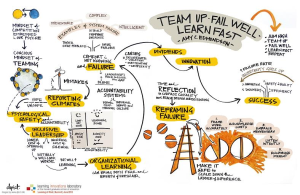
Edmondson’s point is that these three types deserve very different reactions. A basic failure is worth some real frustration, since it could have been avoided. An intelligent failure is closer to just the normal cost of trying something uncertain: a new approach, a new field, something nobody’s done before, and treating it with the same shame or self-criticism as a careless mistake actually discourages exactly the kind of attempts most likely to lead somewhere new.
Edmondson’s earliest research, a 1996 study of hospital nursing teams, shows exactly why this matters. Going in, she expected that better teams would make fewer medication errors than weaker ones. Error rates across the units she studied varied a lot, from about 2.3 to 23.7 errors per 1,000 patient days. But when she compared those numbers to independent ratings of team quality, the result was the opposite of what she expected: teams rated higher on leadership and cohesion actually reported more errors, not fewer.
The real explanation was openness, not more mistakes. Stronger teams had a culture where admitting an error felt safe enough to actually report it, while weaker teams were more likely to hide the same kinds of mistakes instead. The errors were happening either way; what differed was whether they became visible enough to learn from. Losing well, in Edmondson’s view, starts with figuring out which type of loss just happened, and then making sure it is visible enough to yourself and to others and to actually learn from, instead of quietly burying it out of shame.
Losing Well
Put these three ideas together and a pretty consistent picture shows up. Losing hurts less when it is treated as information about one attempt, not a verdict on someone’s ability – a distinction that is easy to say and genuinely hard to hold onto in the moment. Trying to dodge that verdict altogether, by not giving full effort in the first place, protects someone in the short term but quietly wears down the very ability it’s trying to protect. And not every loss teaches the same lesson: a careless mistake calls for correction, while a well-thought-out attempt that just didn’t work out is closer to the normal price of doing anything worthwhile.

None of this makes losing painless. But it does suggest that what actually decides whether a loss defines someone, or just teaches them something, has less to do with the loss itself, and more to do with which of these patterns takes over afterward.
Sources
- Carol Dweck’s research on mindset and the shift from “I failed” to “I am a failure”
Wise Words book summary - Mueller, C. M., & Dweck, C. S. (1998). “Praise for Intelligence Can Undermine Children’s Motivation and Performance.” Journal of Personality and Social Psychology, 75(1), 33–52 Study data summary, 92% vs. 33% challenge-choice figures
- Covington, M. V., & Omelich, C. L. (1979). “Effort: The Double-Edged Sword in School Achievement.” Journal of Educational Psychology, 71(2), 169–182.
ERIC abstract, Self-Worth Protection Scale, University of Tasmania - Edmondson, A. C. (1996). “Learning from Mistakes Is Easier Said Than Done: Group and Organizational Influences on the Detection and Correction of Human Error.” Journal of Applied Behavioral Science, 32(1), 5–28.
- Amy Edmondson, Right Kind of Wrong: The Science of Failing Well (2023), on basic, complex, and intelligent failure.
Harvard Business School / NBM4 summary