When Should You Stop Improving?
“Just a little better” sounds like a harmless goal, but who could argue with improvement? The term “better” is not a destination; it’s a direction, and a direction without a stopping point tends to become its own kind of trap.
The research on practice, perfectionism, and how people weigh their choices all point to the same uncomfortable fact: past a certain point, more effort toward “better” stops paying for itself, and sometimes starts actively costing something.
The Curve Nobody Draws
Improvement rarely moves in a straight line. The most detailed evidence for this comes from one of the most cited studies in the science of skill development: a 1993 investigation by psychologist K. Anders Ericsson and colleagues into what separated elite violinists from good ones.
Reviewing the practice research available at the time, the authors found a consistent pattern across multiple studies: additional practice produced essentially no measurable benefit once it exceeded about four hours a day, and the benefits were already shrinking noticeably past two hours. The most accomplished violinists in their own study did not out-practice everyone else in the room; they practiced with unusual structure, averaging around 3.5 focused hours a day rather than simply grinding longer than their peers.
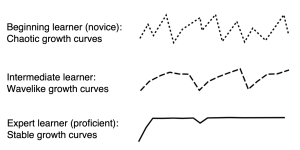
This finding has since become better known, and oversimplified, as the “10,000-hour rule”, the idea that any skill becomes masterable with enough sheer volume of practice. Ericsson himself pushed back on that reading, and a 2019 replication attempt by researchers Brooke Macnamara and Megha Maitra found a notably weaker link between accumulated practice hours and skill level than the original study reported.
The honest takeaway sits between the two extremes: practice matters enormously, but its payoff bends well before most people expect it to, and past a certain point, adding more hours is closer to treading water than improving.
When Trying Harder Becomes the Problem
If the returns on effort taper off, the returns on the mindset that keeps pushing past that point can turn negative altogether. Psychologists Thomas Curran and Andrew Hill tracked this directly in a 2019 meta-analysis covering nearly 42,000 college students across the U.S., Canada, and the U.K. from 1989 to 2016.

Using a standard measure of perfectionism, they found that self-oriented perfectionism, the pressure people put on themselves, rose by about 10 percent over that period, while the pressure people felt from external expectations, called socially prescribed perfectionism, rose by roughly a third. To put the shift in concrete terms: the average student in 2016 scored high enough that they would have ranked at roughly the 66th percentile of the 1989 population, meaning two out of every three young people today report more perfectionism than the typical person did a generation ago.
This trend matters because perfectionism is not a neutral personality quirk. A separate 2017 meta-analysis by researcher Kristin Limburg and colleagues, pooling results across dozens of studies, found consistent moderate associations between perfectionism, particularly the anxious, self-critical kind driven by fear of falling short, and depression, anxiety, and obsessive-compulsive symptoms. The relationship holds even for the more “productive-looking“ form of perfectionism built around ambitious personal standards, not just the form driven by fear of others’ judgment.
- In other words, the psychological cost of chasing “better” without a stopping point is not hypothetical. It shows up reliably in outcomes far less pleasant than the improved outcome the effort was supposed to produce.
The Cost of What You Did Not Do
There is a third piece to this, and it is less about diminishing returns than about what economists call opportunity cost: every hour spent squeezing out a smaller improvement in one area is an hour unavailable for literally anything else, including things with a much steeper, still-rising return curve of their own.
This is easy to lose sight of precisely because optimizing something already in progress feels productive and safe, while starting something new feels uncertain and exposed. The polished draft gets one more read-through; the unfinished second project stays unfinished. The workout routine gets fine-tuned further; the unrelated skill never gets started at all.
None of the research above argues that ambition or high standards are the problem. Ericsson’s own findings show that deliberate, well-structured effort clearly separates strong performers from weak ones. The issue is not effort itself, but effort applied past the point where it is still the best use of that time. The evidence on perfectionism does not condemn wanting to do good work. It shows what happens when the definition of “good enough” keeps moving further away no matter how much is achieved. And opportunity cost does not say every task should be abandoned early, it says every hour of marginal polishing is implicitly a decision not to spend that hour somewhere else, whether or not that decision gets made consciously.
Knowing Where the Curve Bends
Put together, this points to a fairly specific, practical answer to the question of when to stop improving: not “never” and not “as soon as it’s acceptable”, but at the point where the next unit of effort buys less than it costs, measured not only against the task itself, but against everything else that effort could have gone toward instead. Ericsson’s violinists show that this point exists even for world-class performers pursuing mastery in a single domain. Curran and Hill’s data show what happens when a whole generation stops recognizing that point at all. And opportunity cost is the reminder that the meter never actually stops running, even while it feels like the work in front of you is the only thing that matters. Better is genuinely worth pursuing. It is just not, on its own, a reason to keep going.
Conclusion
Across all three strands of evidence, the same shape keeps appearing: effort produces large gains early, smaller gains later, and at some point, gains that are not worth what they cost, whether that cost is measured in wasted hours, in mental health, or in everything else left undone while attention stayed fixed on one more improvement. None of this is an argument for lowering standards or giving up early.
It is an argument for treating “when to stop” as a real question with a real answer, rather than a question that quietly gets answered by default, by fatigue, by fear of falling short, or by never noticing that the curve had already bent. The skill worth building alongside any other is knowing where that point is, and being willing to stop there even when stopping feels, in the moment, like settling for less.
Sources
- Ericsson, K. A., Krampe, R. T., & Tesch-Römer, C. (1993). “The Role of Deliberate Practice in the Acquisition of Expert Performance.“ Psychological Review, 100(3), 363-406. Original study details
- Macnamara, B. N., & Maitram. (2019). “The Role of Deliberate Practice in Expert Performance: Revisiting Ericsson, Krampe & Tesch-Römer (1993).“ Royal Society Open Science.
PMC - Curran, T., & Hill, A. P. (2019). “Perfectionism Is Increasing Over Time: A Meta-Analysis of Birth Cohort Differences From 1989 to 2016.“ Psychological Bulletin, 145(4), 410-429. ScienceDaily summary with percentage figures
- Limburg, K., et al. (2017), meta-analysis on perfectionism and psychopathology.
Summary of associations