
(note: this piece of writing is for someone who is a beginner or already has a basic understanding of the game Tetris. Introduction on the fundamentals such as control key will not be explained, and you will see many jargons in this writing.)
Introduction:
Tetris or in this case modern Tetris, is a game of pattern recognition and fast-thinking. It is a perfect tool to stand out in a party and impress your friends with your incredible “intellectual flexibility” like this:
https://youtu.be/Pt87-8171ok?si=mqff2r-urN_EPPOe
What this player is doing here is more than ten percent of the world. There are multiple players around the world struggling with Tetris handling and piece placement so as a top 8% sprinter,

I’ll walk you through what it takes to become a competent Tetris player. Just a little reminder before we start, clearing 40 lines of blocks without messy holes in your stack is already difficult, let alone clearing it at a high speed of 60 seconds. So yes, prepare yourself mentally as well because this will not be an easy road.
Stacking & Sprinting:
First of all does your stack look like this?
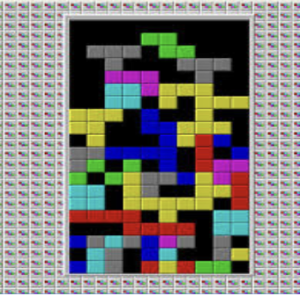
Or like this?
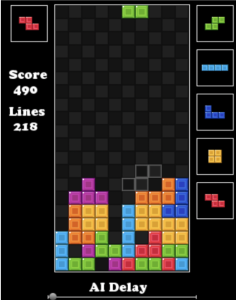
These are examples of a bad stack suggesting a lack of foresight, bad imagination and absolutely terrible stacking knowledge!
But how about this?
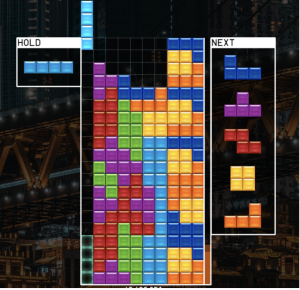
Smooth stacks, no hole and a fairly flat surface that always allows the next piece to be placed down with ease. But trust me when I say that this stack is achievable.
To achieve this smooth stack and also to build it with speed, I’ll introduce you to the process and checklist I’ve created for you by myself after accumulating knowledge and experience in Tetris.
It’s called the 5ps:
Plan:
There are multiple plans to go on about a Tetris 40L sprint. A common and intuitive plan would be to go for a 9-0. A 9-0 stack is a fundamental and common strategy in Tetris, particularly for beginners and in classic games. you stack your pieces in a way that creates a one-column-wide empty space, or “well,” on one side of the playfield. The “9” refers to the nine columns you are filling, and the “0” refers to the one empty column you are leaving open. This opens up opportunities for multiple tetris, potentially stacking your B2B (point-adding mechanics used in versus Tetris).
Additionally, there’s also a more technical one that many if not all of the pros used: 6-3 stacking. 6-3 stacking is a complicated approach that demands foresight and constant practice. I suggest you check out this tutorial here for a more in depth approach.
Pattern:
Onto the next step, you need to know the most common block patterns in Tetris. This way you don’t have to spend too much time on your projection and thinking. In Teris, Some plans will have crucial patterns and others lean more towards freestyling. A plan in particular where block patterns are crucial is the 6-3 stacking.
Here’s some of the block patterns in 6-3 stacking:
- The j,l,o pattern

J will be placed at the bottom followed by O and L on the top, building a 3×4 boxes. This is essential for stacking the “3” column in 6-3 stacking. It can be a repeated pattern as you stack it further
- The s,t,z pattern

T will be placed at the bottom followed by both s and z on its back. This is suitable as a starter for the “6” column in 6-3 stacking. This is a typical starter pattern as there are multiple ways to further stack this, as all of t,s,z, can be placed on this stack.
- The j,o,j or l,o,l stack:

This is a j,o,j stack, to achieve l,o,l you just need to do the opposite way with the l piece instead. This is good for building 3×4 boxes as a replacement of j,l,o when the queue suggests that you have repeated j or l pieces.
Placement:
Finesse (also called movement finesse or two-step finesse) is an input optimization technique used to place down tetrominos while saving keypresses. Each piece in Tetris has its own “finesse” and it is crucial for playing fast and efficiently. This is going to be a lot so check out this wiki and this video for more information.
Projection:
Moving on to the most important part of all the technical skills in Tetris pro play. And yes, emphasis on “pro play” because this technique is very very hard and also very very powerful. Matter of fact, even I, a top 8% tetris player can only project 2 pieces at a time.
So what is projection?
Projection is an act of using your piece queue to imagine what will be the next 1 to 3 to 5 next pieces going on your playfield. A good projection skill will enable you to:
- Play extremely smooth stacks
- Creating high scoring scenarios such as t-spins and tetris
- Holding B2B
- Eliminate piece dependency
For beginners, practice projection alongside your patterns’ practices, because you will need projection to build patterns that you want.
Check out the full guide to projection here.
Perseverance:
I can’t stress this enough but Tetris isn’t a skill you can acquire through the night; it’s almost like practicing an instrument, learning how to control and think like a true pro takes immense effort. Indeed, no idea ever comes to life without efforts, and Tetris playing is not exclusive to that statement. You will need a recommended amount of 30 mins to 1 hour a day of practice to sharpen your Tetris skills to achieve your goal of sprinting. And please, don’t rush the process, play slowly and methodically at first, until all the patterns above are mastered and your projection skill is solid.
If these 5 factors are satisfied, you will notice immense progression after a while, as stated above, always be mindful of these three factors during your reviews and hence improve your play. Then, you will play so smoothly and fast that your friends will react just like the video I showed you at the beginning of this writing – in awe and impressed.